

More than the arm
When your arm hurts, the real problem may not be your arm.
When a pitcher develops elbow or shoulder pain, most people focus on the arm.
But what if the injury started somewhere else?
Recent research suggests that many throwing injuries are influenced by what’s happening farther down the kinetic chain - especially in the hips, trunk and lower body. (Gauthier et al, 2025)
For coaches, parents and athletes, that’s an important shift in thinking.
An arm injury may start in the legs.
We’ve linked the full article, but here are some important highlights to support coaches and parents as they advocate for their athletes.
A Lesson from Baseball History
One of the most famous examples comes from Hall of Fame pitcher Dizzy Dean.
In 1937, Dean fracturing his big toe after being struck by a line drive. This injury changed how he moved and generated force while pitching. Over time, those compensations altered his mechanics and contributed to arm problems that ultimately changed the trajectory of his career.
A toe injury leading to an arm injury sounds strange.
Until you understand the kinetic chain.
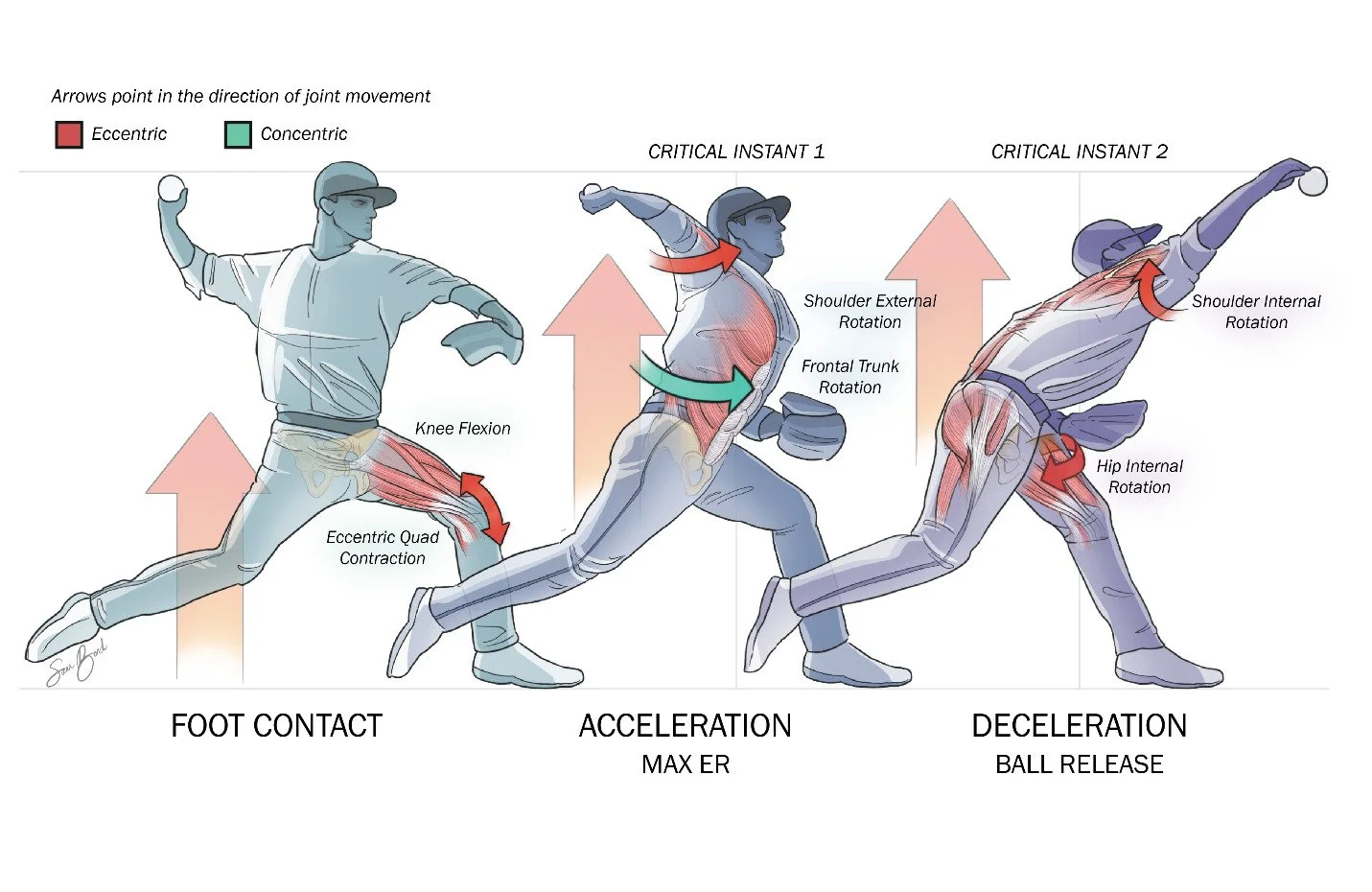
Figure 1. Joint motion and muscle action during foot contact, acceleration, and deceleration phases of the throwing motion.
Artwork by Sam Bond
Link to Image Source
The Body Works as One System
Throwing is a full-body movement.
The legs generate force. The hips and trunk transfer that force. The arm delivers it to the baseball.
When one link in the chain is not working efficiently, another part of the body must pick up the slack.
Findings:
High school pitchers experiencing an upper extremity injury were significantly more likely to present with decreased hip abduction strength off the drive leg. (Hamano et al, 2021)
Pitchers exhibited significantly decreased drive leg hip abductor strength compared to position players, requiring increased demand on the trunk and upper extremity to generate force. (Laudner et al., 2010)
Findings: Trunk rotation power played a significant role in the development of elbow valgus torque (inside part of the elbow associated with Tommy John) and ball speed. (Aguinaldo and Escamilla, 2019)
Findings: Throwing athletes demonstrating decreased lumbopelvic control in single leg stance were significantly more likely to miss over 30 days of a baseball season due to injury. (Chaudari et al., 2019)
Findings: Decreased lumbopelvic control on an athlete’s drive leg was correlated with increased torque at the anterior shoulder and medial elbow. (Laudner et al., 2010)
Roughly 86% of the total energy transferred through the elbow during the throwing motion was due to trunk motion. If you’re a visual person, this gives a great demonstration of the kinetic chain in motion. (Aguinaldo and Escamilla, 2019)
The arm may be where pain shows up, but the source of the problem may be somewhere else.
What This Means for Parents and Coaches
If your athlete develops shoulder or elbow pain, don’t stop the evaluation at the arm.
Ask whether their care team is also assessing:
Hip strength
Single-leg balance and control
Core stability
Trunk rotation power
Lower-body movement patterns
The best injury care looks beyond the symptoms.
Source:
Gauthier ML, Unverzagt CA, Davies GJ. Evaluation and Treatment of Baseball Pitchers: There's More to Assess than the Arm. Int J Sports Phys Ther. 2025 Jan 1;20(1):113-126. doi: 10.26603/001c.127461. PMID: 39758696; PMCID: PMC11698006.